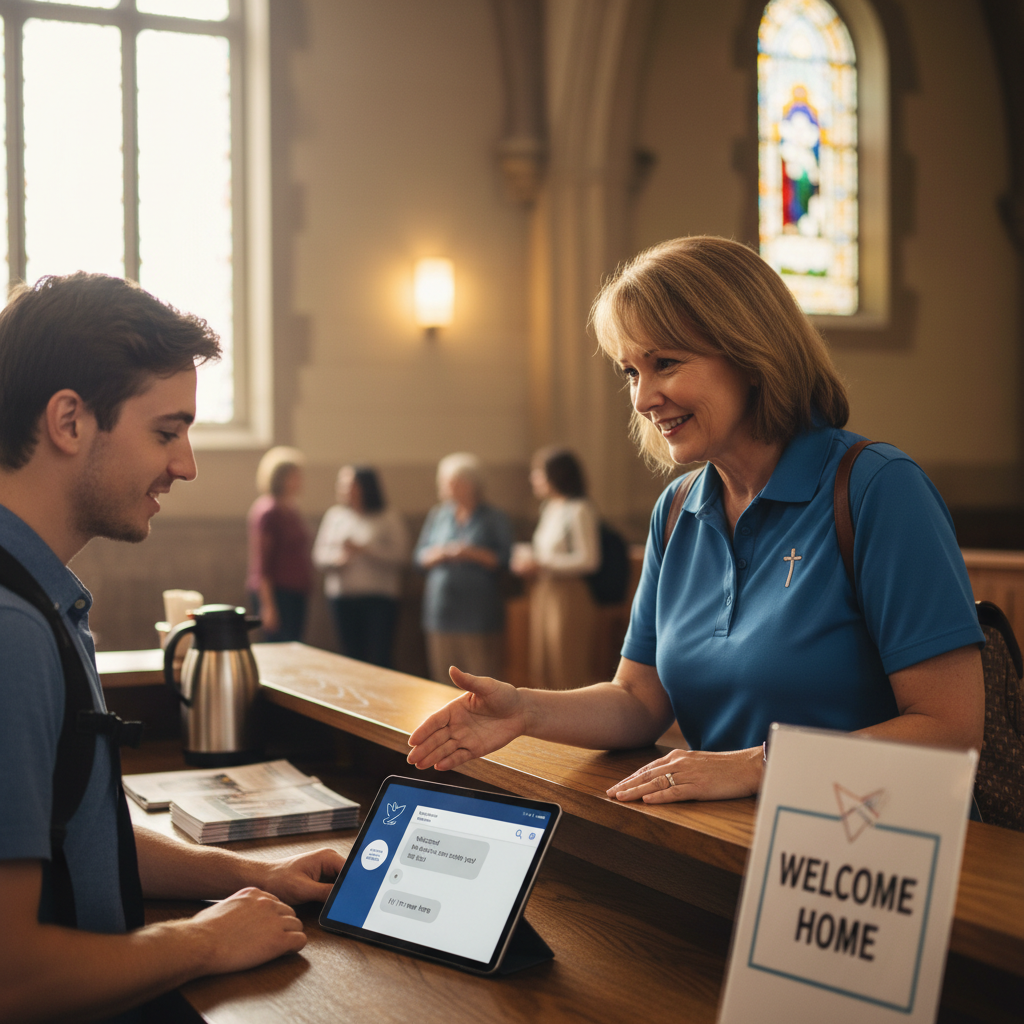
First-time visitors form their impression of your church within the first 7 minutes of arriving. But the real challenge begins after they leave: will they come back? Studies show that only 15% of first-time church visitors return — and the #1 reason they don't is that nobody followed up. Not because the church doesn't care, but because manual follow-up is slow, inconsistent, and falls through the cracks.
AI chatbots are changing this. A ministry-trained chatbot can follow up with every visitor instantly, personally, and consistently — turning a 15% return rate into a 55% return rate. In this article, we'll explore how.
The Church Visitor Follow-Up Problem
Most churches rely on connection cards — visitors fill out a paper card, a volunteer types the info into a spreadsheet, and someone sends an email or makes a phone call "sometime that week." The problems are obvious:
- Delay: Visitors receive follow-up 3-7 days later — by then, the moment has passed
- Inconsistency: Some visitors get called, others get an email, some get nothing
- Volunteer burnout: Following up manually doesn't scale as visitor volume grows
- Lost cards: Paper cards get lost, smudged, or illegible
- No personalization: A generic "thanks for visiting" email feels like spam
A visitor who receives a personalized follow-up within 1 hour of leaving the church is 3x more likely to return than one who hears back a week later.
How AI Chatbots Solve the Follow-Up Problem
1. Instant, Automated First Touch
When a visitor fills out a digital connection card on your website or app, the AI chatbot sends a personalized message within seconds:
- "Hi Sarah! Thanks for joining us at MyChurch today. Pastor John mentioned you visited for the first time — we'd love to help you take your next step. What questions can I answer?"
- The message references the specific service they attended
- It offers immediate next steps: upcoming events, small groups, a newcomer's lunch
- It invites a two-way conversation, not just a one-way broadcast
2. 24/7 Question Answering
Visitors have questions at all hours — Saturday night as they decide whether to come, Sunday afternoon as they reflect, Monday morning as they consider returning. An AI chatbot isalways available:
- "What time is the service?" — answered instantly, 3 AM or 3 PM
- "Is there childcare for my 3-year-old?" — immediate, accurate answer
- "What denomination is this church?" — consistent, theologically accurate response
- "What should I wear?" — friendly, welcoming guidance
- "How do I get involved in a small group?" — step-by-step instructions with a link to join
3. Personalized Welcome Flows
AI chatbots create personalized welcome sequences based on what the visitor shares:
- A young couple with kids receives info about children's ministry and family events
- A college student receives info about the young adults group and service opportunities
- A retiree receives info about seniors' ministry and weekday Bible studies
- Someone exploring faith receives a gentle "Start Here" resource series
- Someone relocating receives info about community groups and neighborhood connections
4. Multi-Touch Follow-Up Sequences
One message isn't enough. AI chatbots automate a multi-touch follow-up sequence:
- Day 0 (Sunday afternoon): "Thanks for visiting! Here's what's happening this week."
- Day 2 (Tuesday): "Did this week's message resonate? Here's the sermon replay and a short devotional."
- Day 4 (Thursday): "We'd love to invite you to our newcomer's lunch this Sunday after service. Tap to RSVP."
- Day 7 (next Sunday): "Hope to see you again today! Here's what to expect this week."
- Day 14: If they haven't returned, a gentle check-in: "We've missed you! Is there anything we can pray for?"
Beyond Visitors: Ongoing Member Engagement
Chatbots aren't just for first-time visitors. They serve your entire congregation:
- Prayer support: Members can submit prayer requests anytime and receive prayer from the bot while awaiting pastoral follow-up
- Next steps guidance: "I want to get baptized" or "I want to join a small group" — the bot guides them through the process
- Event registration: "How do I sign up for the retreat?" — instant answer with a registration link
- Sermon questions: "I didn't understand the part about grace in Sunday's sermon" — the bot references the sermon and provides clarification
- Crisis routing: Sensitive messages ("I'm struggling with depression") are immediately routed to pastoral staff
Building a Chatbot People Actually Trust
A poorly designed chatbot feels robotic and unhelpful. A well-designed ministry chatbot feels like a knowledgeable, caring member of your team. The difference is in the training:
- Train on your content: The bot should know your church's beliefs, programs, service times, staff, and history
- Set theological boundaries: Define what the bot can and can't answer — and route theological questions to pastors
- Be transparent: Always identify the bot as AI — never pretend it's human
- Human escalation: Any sensitive topic (prayer crisis, counseling, salvation questions) instantly routes to a real person
- Warm tone: The bot's language should reflect your church's voice — welcoming, hopeful, grace-filled
- Continuous improvement: Review chatbot transcripts weekly and refine responses based on real conversations
Measuring Chatbot Impact
Track these metrics to measure your chatbot's effectiveness:
- Return-visit rate: What percentage of first-time visitors come back? (Target: 40-55%)
- Response time: Average time between visitor sign-up and first follow-up (Target: under 1 minute)
- Conversation engagement: What percentage of visitors engage in a two-way conversation with the bot?
- Next-step conversion: How many visitors take a next step (attend an event, join a group, meet with a pastor)?
- Human escalation rate: What percentage of conversations are routed to staff? (Healthy: 5-10%)
Addressing Common Concerns
"Isn't a chatbot impersonal?"
Not following up at all is far more impersonal. A chatbot doesn't replace human connection — it ensures no visitor falls through the cracks while freeing up your staff to focus on deep, personal pastoral care.
"What if the bot says something wrong theologically?"
That's why theological boundaries and human escalation are critical. The bot handles practical questions (service times, childcare, events) and routes spiritual questions to your pastoral team.
"Will members feel like they're talking to a machine?"
Transparency builds trust. When members know the bot is AI and that a human is always available, they appreciate the instant responses — and use the bot for what it does best: quick, practical answers.
Getting Started with a Ministry Chatbot
At MyChurch, we build custom AI chatbots trained on your church's unique content and beliefs. Every chatbot we build includes:
- Custom training on your church's website, sermons, beliefs, and programs
- Automated visitor follow-up sequences with personalized welcome flows
- 24/7 question answering on your website and church app
- Human escalation for sensitive or theological questions
- Multi-language support for diverse congregations
- Analytics dashboard tracking engagement, conversions, and escalation
- Theological boundaries configured with your pastoral team
Stop losing visitors to slow follow-up. Schedule a free consultation and let us show you how an AI chatbot can transform your visitor retention and member engagement.
Ready to Transform Your Church's Digital Presence?
Schedule a free consultation with our ministry technology experts and discover how a custom church app or AI-powered tools can grow your congregation.
Book Consultation →