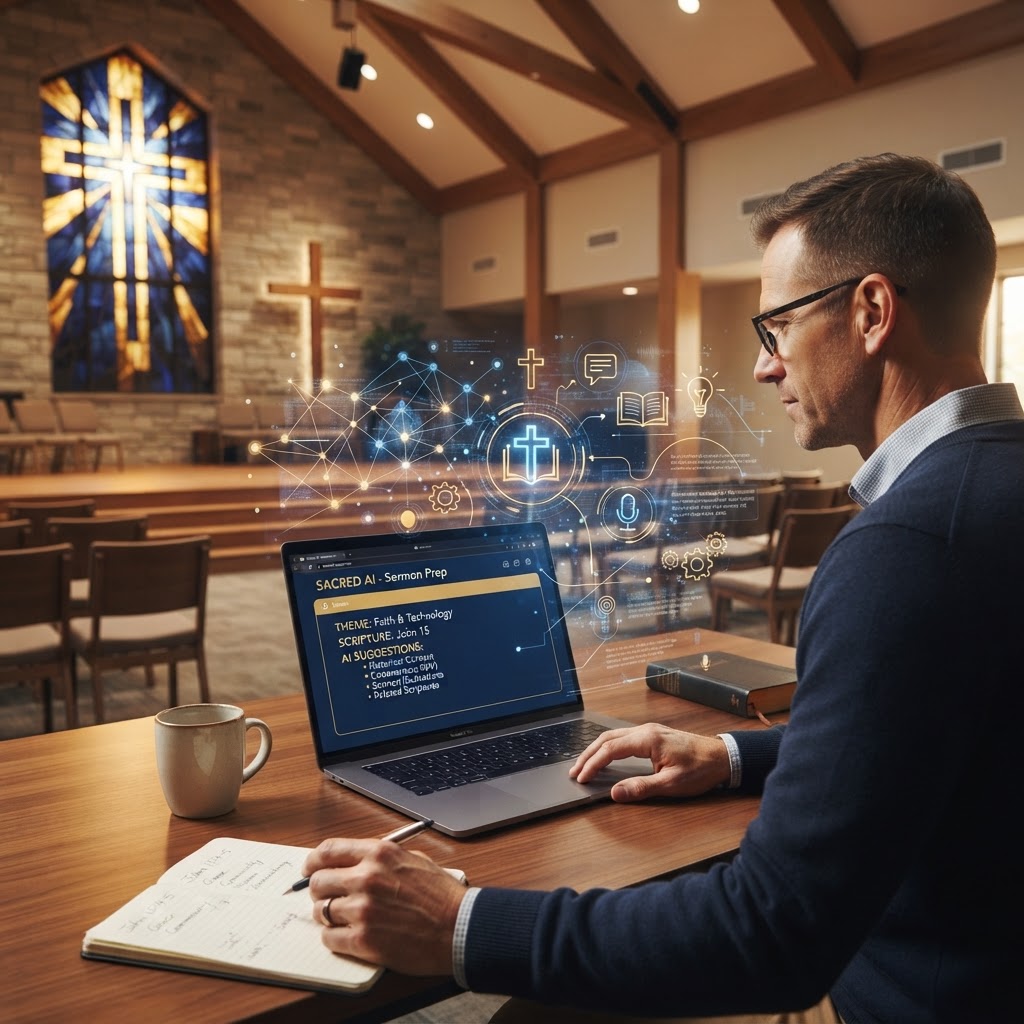
Most pastors are already past the question of whether to use AI. The 2025 State of AI in the Church survey found that 91% of church leaders support using AI in ministry and 61% use it weekly or daily. Sermon prep is the most common use — 64% of pastors lean on AI there in some way.
Here is the part that should give you pause: in that same survey, 73% of ministries had no AI policy at all, and only 6% had a written one. So the real gap is not adoption — it is that churches are pouring AI into sermon prep, graphics, and communication without ever deciding, in writing, where it stops. This guide is built around closing that gap. Every tool below comes with a use case, but the last section is the one to read first: the line you should not cross.
AI is good at the busywork that eats a ministry team's week. It is no substitute for the Holy Spirit, a real pastor, or one person sitting with another. Keep that straight and the rest of this is genuinely useful.
Whether you're a micro church with an all-volunteer staff or a multisite megachurch, these 18 practical ways to use AI in your church will save your team 10–80 hours per week — and help you reach more people with the Gospel.
1. Sermon Preparation and Research
Sermon prep is where most pastors already use AI — and for good reason. AI can help you brainstorm sermon series ideas, generate sermon outlines, find relevant Scripture cross-references, research historical and cultural context, and even suggest illustrations. What used to take 8–10 hours of research can be compressed into 2–3 hours, freeing you to focus on prayer, exegesis, and delivery.
How to use it: Ask an AI assistant to suggest sermon angles on a passage, generate discussion questions for small groups, or summarize commentaries. Always verify every theological claim against Scripture and your own study — AI is a research assistant, not a theologian.
Learn more in our guide on AI-powered sermon preparation and how pastors use AI to write sermons.
2. Sermon Series Graphics and Social Media Images
AI image generation has leveled the playing field for small churches. A volunteer can now create professional sermon series graphics, social media posts, and announcement slides that used to require a professional designer — or a budget none of them had. Tools like AI image generators can produce custom artwork for every sermon series in minutes.
How to use it: Describe the visual concept for your sermon series (e.g., "a lighthouse on a stormy sea, dramatic lighting, cinematic") and generate multiple options. Use the best one for your slides, social media, and website banner — all branded consistently.
3. Video Creation and Editing
AI video tools can turn your sermon audio into short video clips for social media, generate promotional videos for upcoming events, and even create animated text overlays for key sermon points. This is how you reach the 76% of people who consume content through video rather than text.
How to use it: Upload your sermon recording and let AI identify the most shareable 60-second clips, add captions automatically, and format them for Instagram Reels, TikTok, and YouTube Shorts — all without a video editor.
4. Worship Music and Audio Production
AI music generation tools can create background music for prayer moments, original worship song demos, and ambient tracks for meditation and reflection. While AI-generated music shouldn't replace your worship team, it can enhance special moments, transitions, and multimedia experiences that would otherwise require licensing or a studio.
How to use it: Generate royalty-free background tracks for prayer walks, youth group events, or video content. Use AI to demo original worship songs before bringing them to your worship team for refinement.
5. Real-Time Translation for Multilingual Services
If your congregation includes non-English speakers, AI translation can display real-time subtitles on screens or on members' phones during the service. This makes your church accessible to diverse communities without requiring a human translator for every service.
How to use it: Use AI-powered translation tools that listen to the live sermon and display translated text on a secondary screen or via a mobile app. Some tools support 50+ languages with surprisingly high accuracy for spoken content.
6. Automated Visitor Follow-Up
The most critical moment in a visitor's journey is the 48 hours after their first visit. AI chatbots can instantly engage first-time visitors on your church website, answer their questions, invite them to a next step, and capture their contact information for pastoral follow-up — 24/7, even when your office is closed.
How to use it: Deploy an AI ministry chatbot on your church website that greets visitors, answers questions about service times and beliefs, and captures prayer requests. Learn more about AI chatbots for church visitor follow-up and explore our AI Ministry Chatbot service.
7. Automated Sermon Notes and Summaries
AI can transcribe your sermon in real time and generate structured sermon notes, small group discussion questions, and devotionals based on the message — all automatically. This turns one sermon into a week's worth of discipleship content without any additional staff effort.
How to use it: Upload your sermon audio or video to an AI transcription tool. Use the transcript to generate a sermon summary, key takeaways, and discussion questions for small groups. Publish these in your church app or email newsletter.
8. Sermon-to-Content Repurposing
One 40-minute sermon contains enough content for an entire week of social media posts, a blog article, a newsletter, and a devotional. AI can extract key quotes, generate social media captions, write blog summaries, and create email content — all from a single sermon transcript.
How to use it: Feed your sermon transcript into an AI writing tool and ask it to generate: 5 social media posts with key quotes, a 500-word blog summary, a devotional based on the main passage, and a weekly newsletter intro. One sermon, seven pieces of content.
9. Prayer Request Management and AI Prayer Assistants
AI can help manage the influx of prayer requests your church receives — categorizing them, routing urgent requests to pastoral staff, and even composing thoughtful prayer responses. An AI prayer assistant can pray with people at 2 AM when no pastor is available, using Scripture-based responses.
How to use it: Integrate an AI chatbot on your website or app that receives prayer requests, categorizes them by urgency, sends emergency requests to pastoral staff immediately, and responds to the requester with a Scripture-based prayer. See our prayer wall guide for more.
10. Church Administration and Operations
AI can automate the administrative busywork that consumes your staff's week: drafting emails, generating meeting agendas, summarizing meeting notes, creating volunteer schedules, managing the church calendar, and even drafting policies. What used to take an admin 10 hours can be done in 2.
How to use it: Use AI to draft weekly newsletters, meeting summaries, volunteer schedules, and policy documents. Always have a human review before sending. Learn more about AI in church administration.
11. AI Obituary and Memorial Writing
Writing an obituary or memorial tribute during a time of grief is emotionally taxing. AI can help grieving families draft a thoughtful, personalized obituary by asking a few questions about their loved one's life, faith, and legacy — then generating a respectful, well-structured tribute they can edit and finalize.
How to use it: Use an AI writing assistant to draft obituaries for families who request help. Input key life details, faith journey, and family information, and generate a compassionate first draft. Learn more in our guide on AI obituary assistants.
12. AI Receptionist for Church Offices
An AI receptionist can answer your church office phone 24/7, handle common inquiries (service times, address, event details), route calls to the right staff member, and even take prayer requests over the phone. This ensures no call goes unanswered — even on evenings, weekends, and holidays.
How to use it: Set up an AI phone assistant that answers calls with your church's greeting, answers FAQs, and routes urgent calls to on-call staff. See our guide on AI receptionists for churches.
13. Personalized Church Communication
AI can segment your congregation based on life stage, interests, and engagement — then personalize communications accordingly. New parents get different content than empty nesters. First-time visitors get a different follow-up sequence than long-time members. This level of personalization used to require a full-time communications director.
How to use it: Use AI to analyze your congregation data and create targeted email sequences for different segments. Learn more about AI personalizing church communication.
14. AI-Assisted Message Blasts
Sending a text or email blast to your congregation? AI can help craft the message for maximum engagement — suggesting subject lines, optimizing send times, and even personalizing the greeting for each recipient. AI can also analyze which messages get the best response and refine future blasts.
How to use it: Use AI to draft and optimize your message blasts. See our guide on AI message blasts for churches.
15. AI Book Creator for Pastors
Many pastors have a book inside them — a sermon series, a Bible study, or a ministry memoir. AI can help turn sermon transcripts, notes, and ideas into a structured book manuscript, complete with chapters, illustrations, and a cohesive narrative arc. This makes publishing accessible to any pastor with a message.
How to use it: Compile your sermon series transcripts and use AI to organize them into a book structure, expand key points, and generate transitional content. Learn more about AI book creators for pastors.
16. AI for ADA Accessibility
AI-powered accessibility widgets can make your church website ADA-compliant automatically — adding screen reader optimization, keyboard navigation, color contrast adjustments, and text resizing. Some tools even use AI to generate alt text for images and simplify complex language for cognitive accessibility.
How to use it: Install an AI-powered accessibility widget on your church website. See our ADA Accessibility service and read about why your church needs ADA compliance.
17. External-Facing AI Chatbots for Outreach
Beyond your website, AI chatbots can be deployed on your church's Facebook page, Instagram DMs, and Google Business Profile — engaging people where they already are. Someone messaging your church at 11 PM with a question about God gets an immediate, thoughtful, Scripture-based response instead of waiting until office hours.
How to use it: Deploy AI chatbots across your social channels that can answer questions, share the Gospel, and invite people to church. See our guide on AI external chatbots for churches.
18. AI Sermon Writing and Outline Generation
While AI should never replace the Holy Spirit's guidance in sermon preparation, it can be a powerful tool for generating sermon outlines, structuring messages, finding illustrations, and even suggesting sermon series themes based on the church calendar or current events. The key is using AI as a collaborator, not a replacement.
How to use it: Use AI to generate sermon outlines, find illustrations, and brainstorm sermon series. Always refine with your own study, prayer, and theological discernment. See our guide on AI sermon writing tools.
Where AI Should Never Go in Your Church
This is the section to read first. AI is a tool, not a pastor. Here is where the line should be drawn:
- Pastoral care and counseling: AI cannot sit with a grieving widow, hold the hand of a dying saint, or look a struggling addict in the eye. Pastoral presence is irreplaceable.
- Confession and spiritual direction: AI is not a confessor or a spiritual director. These require a real human relationship built on trust and accountability.
- Theological authority: AI can hallucinate Scripture, misattribute quotes, and generate plausible-sounding but wrong theology. Every AI-generated theological claim must be verified against Scripture and orthodox doctrine.
- Sermon delivery: AI can help prepare a sermon, but the preaching must come from a human who has wrestled with the text and heard from God. A sermon preached by AI is not a sermon — it's a performance.
- Final decisions on membership, discipline, and leadership: These require human wisdom, spiritual discernment, and community accountability.
How to Create an AI Policy for Your Church
With 73% of churches having no AI policy, this is the single most important step you can take. Your policy doesn't need to be complex — it needs to answer four questions:
- What will we use AI for? (Sermon prep, graphics, admin, etc.)
- What will we never use AI for? (Counseling, confession, sermon delivery, theological authority)
- Who is responsible for reviewing AI output? (Every AI-generated content must be reviewed by a human before publishing)
- How will we be transparent? (Will you disclose when AI was used? How?)
For a deeper dive into the ethical framework, read our guides on what the Bible says about AI, how churches can use AI without replacing ministry, and how a church should use AI responsibly.
Real ROI: How Much Time and Money Can AI Save Your Church?
The time savings depend on your church size, but here's what churches are reporting:
- Micro church (under 80 members): ~3 hours/week saved
- Rural small church (80–150 members): ~8 hours/week saved
- Suburban small church (200–400 members): ~14 hours/week saved
- Urban medium church (800–1,500 members): ~30 hours/week saved
- Megachurch (3,000+ members): ~80 hours/week saved
At an average staff cost of $25/hour, a suburban small church saves $18,200/year in staff time. A megachurch saves over $104,000/year. The ROI is not theoretical — it's measurable.
How to Get Started with AI in Your Church
- Start with one use case: Don't try all 18 at once. Pick the one that saves the most time (usually sermon prep or graphics) and master it
- Write your AI policy first: Before anyone on your team uses AI, decide where the line is
- Train your team: Give your staff and volunteers a 30-minute training on how to use AI tools effectively and ethically
- Always verify: Every AI output — especially theological claims — must be reviewed by a human
- Measure results: Track time saved and content quality so you can justify the investment
Want help implementing AI in your church? Book a free consultation — we help churches deploy AI chatbots, sermon tools, and accessibility solutions that serve the mission without replacing the minister. Explore our AI Ministry Chatbot service and AI Church Assistant to see what's possible.
Frequently Asked Questions About Using AI in Church
Is it biblical to use AI in church?
The Bible doesn't mention AI directly, but it does speak to wisdom, stewardship, and using tools to advance the Gospel. AI is a tool — like a printing press, a microphone, or a projector. The question isn't whether AI is biblical, but whether the way you use it honors God, serves people, and stays grounded in Scripture. Read our deeper guide on what the Bible says about AI.
What are the most practical ways to use AI in a church?
The most practical uses are: sermon preparation and research, sermon series graphics, video clip creation for social media, real-time translation for multilingual services, automated visitor follow-up chatbots, sermon-to-content repurposing, prayer request management, and church administration tasks. These use cases save the most time and have the lowest risk of theological error.
What AI tools should churches avoid?
Churches should avoid using AI for pastoral counseling, confession, spiritual direction, theological authority, sermon delivery, and final decisions on membership or discipline. AI should also never be used to generate content that is presented as human-authored without disclosure — transparency builds trust.
How much does it cost to use AI in a church?
Many AI tools have free tiers that are sufficient for small churches. Paid AI subscriptions typically range from $10–$50/month per tool. A full AI ministry chatbot deployed on your church website starts at around $50–$200/month depending on features. The ROI in saved staff time typically pays for the cost within the first month.
Can AI replace a pastor?
No. AI can assist with research, content creation, and administrative tasks, but it cannot provide pastoral care, spiritual discernment, relational presence, or Spirit-led preaching. The role of a pastor is fundamentally relational and spiritual — two things AI cannot do. AI is a tool that serves pastors; it does not replace them. Read more about using AI without replacing ministry.
Ready to Transform Your Church's Digital Presence?
Schedule a free consultation with our ministry technology experts and discover how a custom church app or AI-powered tools can grow your congregation.
Book Consultation →