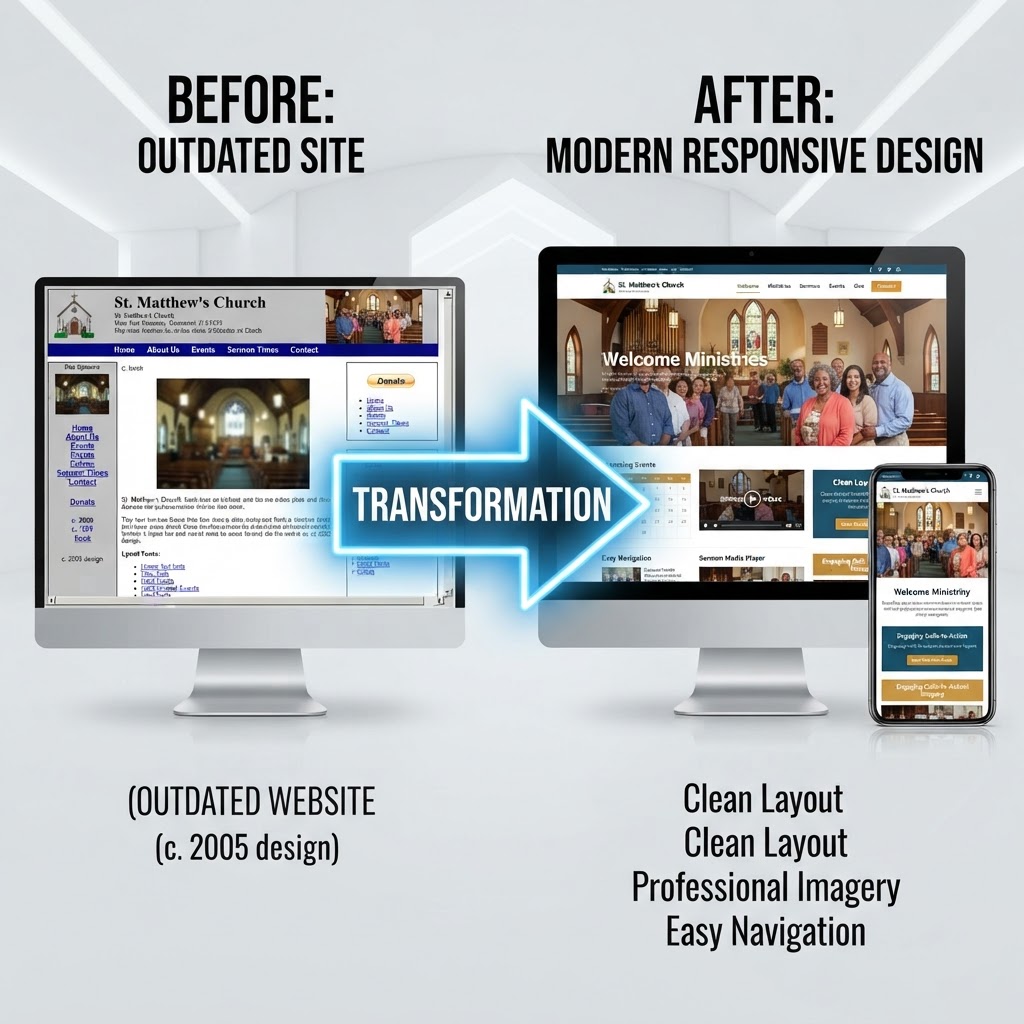
A church website redesign is one of the highest-ROI investments your ministry can make. A dated, slow, or confusing website silently turns visitors away every single day. A strategic redesign can double your website traffic, increase online giving, and bring more first-time visitors through your doors.
But a redesign done wrong — rushed, unplanned, or focused on aesthetics instead of strategy — can actually hurt your ministry. In this guide, we will walk through a proven step-by-step church website redesign strategy for 2025.
Signs Your Church Website Needs a Redesign
How do you know when it is time for a redesign? Here are the most common signs:
- It looks dated: The design feels like it was built 5+ years ago — because it probably was
- It is not mobile-friendly: The site is hard to read or navigate on a phone
- It loads slowly: Pages take more than 3 seconds to load, and visitors leave
- Service times are hard to find: The #1 thing visitors look for is buried
- No online giving: Or the giving process is clunky and multi-step
- Content is outdated: The last sermon was posted months ago, events are stale
- Not ADA compliant: Your site is not accessible to members with disabilities
- Not ranking on Google: When someone searches "churches near me," you do not appear
- No clear calls-to-action: Visitors land on your site and do not know what to do next
- It was built on a platform you have outgrown: A DIY builder that no longer meets your needs
For a deeper dive, read our guide on 9 signs your church website needs a redesign.
The Church Website Redesign Strategy: Step by Step
Step 1: Define Your Goals
Before touching a single pixel, define what you want your redesigned website to achieve. Common church website goals include:
- Increase first-time visitor attendance by 25%
- Increase online giving by 30%
- Improve Google rankings for local church searches
- Improve engagement with sermons and events
- Achieve ADA compliance
- Integrate with a church app
Your goals will shape every decision that follows — from design to content to features.
Step 2: Audit Your Current Website
Before redesigning, understand what is working and what is not. Check:
- Analytics: Which pages get the most traffic? Where do visitors drop off?
- Speed: Run a Google PageSpeed Insights test — anything under 50 needs serious work
- Mobile usability: Test your site on multiple phones and tablets
- Accessibility: Run an ADA compliance audit
- SEO: Check your Google Search Console for rankings and keyword data
- Content inventory: List every page, what it says, and whether it needs updating
Step 3: Research and Plan
Look at other church websites — both in your area and beyond. Take note of what works and what does not. Then plan your new site structure:
- Map out your page hierarchy and navigation menu
- Identify the essential pages you need (homepage, visit, about, sermons, events, give, contact)
- Plan your content strategy — who will write what, and when
- Gather authentic photos of your church, people, and ministries
- Define your calls-to-action for each page
Learn more about planning your content in our church content strategy guide.
Step 4: Design and Build
This is where strategy meets aesthetics. Key design principles for a church website redesign:
- Mobile-first: Design for the phone first, then scale up to desktop
- Fast and lightweight: Optimize every image and script
- Clear navigation: No more than 6-7 top-level menu items
- Authentic imagery: Real photos of your congregation, not stock photos
- Clear calls-to-action: Every page guides visitors to a next step
- ADA compliant: Accessibility built in from the start, not bolted on
- SEO-optimized: Proper meta tags, schema markup, and heading structure
Read our complete church website design guide for more details.
Step 5: Add Essential Features
A modern church website redesign should include:
- Online giving: Secure, one-tap giving from any page — see church donation software
- Sermon library: Audio, video, notes, and search — see sermon audio
- Events calendar: With registration and reminders
- AI chatbot: 24/7 visitor engagement — see AI chatbots for churches
- ADA accessibility widget: For screen readers, text resizing, contrast adjustment
- Google Analytics 4: To track visitor behavior and measure success
- Local SEO: Google Business Profile optimization and local keyword targeting
Step 6: Test and Launch
Before going live, test everything:
- Test on multiple devices — phones, tablets, desktops
- Test on multiple browsers — Chrome, Safari, Firefox, Edge
- Run a speed test and fix any issues
- Run an ADA compliance audit
- Test all forms — contact, prayer request, give
- Check all internal links
- Set up 301 redirects from old URLs to new ones to preserve SEO rankings
- Submit your new sitemap to Google Search Console
Step 7: Post-Launch Optimization
A website is never "done." After launch, continue to:
- Publish fresh content — blog posts, sermons, events
- Monitor analytics and adjust based on visitor behavior
- Keep content updated — remove old events, update service times
- Run regular speed and ADA compliance checks
- Update software and plugins for security
How Much Does a Church Website Redesign Cost?
The cost of a church website redesign varies based on scope, features, and who builds it. Read our complete church website cost guide for a full breakdown. Generally:
- DIY builder: $20-$50/month, but limited customization and SEO
- Freelancer: $1,000-$5,000, but quality and reliability vary widely
- Full-service agency: $2,000-$10,000+ for a custom, SEO-optimized, ADA-compliant site
- Ongoing management: $200-$500/month for updates, hosting, and support
A church website redesign is not an expense — it is an investment in your ministry's growth. A well-designed site pays for itself in new visitors, increased giving, and deeper engagement.
Common Redesign Mistakes to Avoid
- Redesigning without strategy: A pretty site that does not serve visitors is still a failure
- Ignoring mobile: Over 60% of your visitors are on phones
- Forgetting SEO: A new site that does not rank is invisible
- No ADA compliance: Excluding members and risking legal action
- Not planning content: A beautiful site with outdated content still fails
- Not setting up redirects: Losing all your old Google rankings
- No ongoing management plan: The site goes stale within months of launch
Ready to Redesign Your Church Website?
At MyChurch, we have been designing and building church websites since 2010. Our redesigns are strategic, not just aesthetic. Every site we build includes:
- Custom design that reflects your church's unique identity
- Mobile-first, lightning-fast performance
- Local SEO optimization for higher Google rankings
- ADA compliance from day one
- AI chatbot for 24/7 visitor engagement
- Online giving, sermon library, events calendar, and more
- Seamless integration with your church app
- Ongoing management, updates, and support
Is it time to redesign your church website? Schedule a free consultation and let us show you what a strategic redesign can do for your ministry.
Ready to Transform Your Church's Digital Presence?
Schedule a free consultation with our ministry technology experts and discover how a custom church app or AI-powered tools can grow your congregation.
Book Consultation →