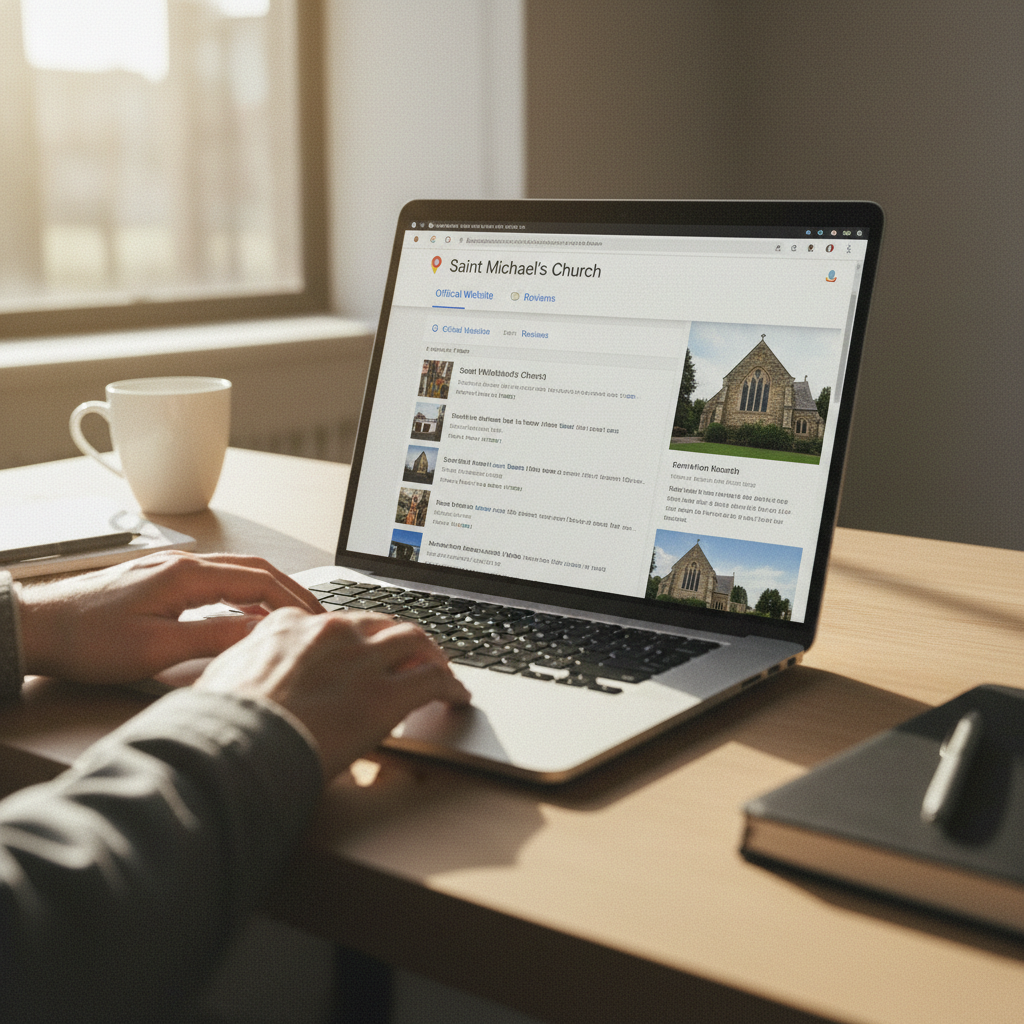
Every week, thousands of people in your community type phrases like "churches near me," "non-denominational church in [city]," or "church with childcare near me" into Google. These are people actively looking for a church home — not scrolling past a social media post, not clicking a billboard, but intentionally searching for a faith community.
Local SEO is how you make sure your church shows up when they do. In this article, we'll cover the practical, proven strategies that help churches rank higher on Google, reach more seekers, and grow their congregations through search.
SEO isn't about gaming Google. It's about making sure that when someone in your community is searching for God, your church is there to meet them.
What Is Local SEO (and Why It Matters for Churches)
Local SEO is the practice of optimizing your online presence to rank higher in location-based searches. When someone searches "churches near me" or "church in [city]," Google shows a local pack — the map with three pinned results at the top of the page. That local pack is the most valuable real estate in church search.
Here's why local SEO is uniquely powerful for churches:
- High intent: People searching "churches near me" are ready to visit — they're not casual browsers
- Geographic precision: You're reaching people in your actual community, not a random national audience
- Free traffic: Unlike ads, organic search traffic costs nothing — it compounds over time
- Trust signal: Ranking at the top of Google signals credibility to seekers
- 24/7 visibility: Your church shows up in search results at 2 AM on a Tuesday — when someone's going through a crisis
Step 1: Claim and Optimize Your Google Business Profile
Your Google Business Profile (formerly Google My Business) is the single most important local SEO asset you have. It's what powers your church's appearance on Google Maps and in the local pack. Here's how to optimize it:
- Claim your profile: Search for your church on Google Maps, click "Claim this business," and verify
- Complete every field: Service times, address, phone, website, denomination, description — leave nothing blank
- Choose the right category: "Church" or "Religious organization" as primary; add relevant secondary categories
- Upload photos: Exterior, interior, staff, events, kids' ministry — profiles with photos get 35% more clicks
- Post weekly updates: Share upcoming events, sermon series, and church news through the posts feature
- Enable messaging: Let seekers message you directly from your Google listing
- Keep hours updated: Holiday schedules, summer hours, special services — keep them current
Step 2: Target Local Keywords on Your Website
Your website content needs to include the phrases people in your community are actually searching. The key is to be specific and local:
- "Church in [City Name]" — on your homepage title and header
- "[City Name] church service times" — on your service times section
- "Churches near [Neighborhood/Landmark]" — in your location or directions page
- "[City Name] youth ministry" / "[City Name] kids church" — on your ministries pages
- "Non-denominational church in [City]" / "Baptist church in [City]" — match your tradition
- "Church with [feature] in [City]" — e.g., "church with contemporary worship in [City]"
Don't stuff keywords unnaturally. Write for humans first, then make sure the local phrases are naturally present. Create dedicated pages for each ministry — "Youth Ministry in [City]," "Kids Church in [City]" — because each page can rank for its own set of searches.
Step 3: Create Content That Answers Seeker Questions
Every blog post, FAQ, and resource page on your church website is an opportunity to rank for a question someone is asking Google. Think about what seekers and members in your community are searching for:
- "What to expect at a church service" → Write a "Plan Your Visit" page
- "How to find a church" → Write a blog post guiding seekers through the process
- "What does [denomination] believe?" → Write a beliefs page
- "Church events in [City]" → Keep a regularly updated events page
- "Christian counseling in [City]" → If you offer counseling, create a dedicated page
- "VBS [City] 2025" → Create a page for your Vacation Bible School each year
- "Christmas Eve service [City]" → Create seasonal pages for major services
Each piece of content should be genuinely helpful, not just keyword bait. Google's algorithm increasingly rewards helpful, original content — and so do the people reading it.
Learn more about building a strong website foundation in our guide on why your church website is your digital front door.
Step 4: Get and Manage Online Reviews
Reviews are a major local SEO ranking factor — and they're also a powerful trust signal for seekers. Here's how to build a strong review presence:
- Ask your members: After a great service or event, invite members to leave a Google review
- Make it easy: Provide a direct link to your Google review form in your newsletter and app
- Respond to every review: Thank people for positive reviews; respond graciously to any negative ones
- Don't fake reviews: Google penalizes fake reviews — and seekers can spot them
- Diversify platforms: Google is most important, but Facebook reviews also matter
A church with 50+ genuine, positive Google reviews will almost always outrank a church with 3 reviews — all else being equal.
Step 5: Technical SEO Fundamentals
Behind the scenes, there are technical factors that significantly affect your rankings:
- Fast load speed: Google penalizes slow sites. Aim for under 3 seconds
- Mobile optimization: Over 60% of church searches are on mobile — a mobile-unfriendly site won't rank
- SSL certificate: Your site must be HTTPS (secure) — Google flags non-secure sites
- Schema markup: Structured data that tells Google "this is a church, here are our service times, here's our address"
- XML sitemap: A map of all your pages that helps Google find and index them
- Clean URL structure: /blog/church-seo not /p=12345
- Internal linking: Link between your pages so Google understands your site structure
- ADA accessibility: Accessible sites rank better — Google rewards good user experience for everyone
Learn more about accessibility in our guide on ADA compliance widgets for church websites.
Step 6: Build Local Citations and Backlinks
A "citation" is any online mention of your church's name, address, and phone number (NAP). Consistent citations across the web signal to Google that your church is a real, established local organization. Make sure your church is listed on:
- Google Business Profile (most important)
- Bing Places for Business
- Apple Maps
- Facebook page
- Yelp
- Your denomination's directory (if applicable)
- Local chamber of commerce
- Community event directories
The key is NAP consistency — your name, address, and phone number must be identical everywhere. Inconsistent citations confuse Google and hurt your rankings.
Step 7: Track and Improve
SEO isn't set-it-and-forget-it. Use these free tools to monitor your progress:
- Google Search Console: See exactly which searches are bringing people to your site
- Google Analytics: Track how visitors behave once they arrive
- Google Business Profile insights: See how many people viewed your listing, called, or clicked
- Local rank trackers: Monitor where you rank for your target keywords over time
Look at the data monthly. What searches are growing? What pages get the most traffic? What's your biggest opportunity? SEO rewards consistent, patient effort — churches that commit to it see compounding growth over months and years.
How MyChurch Helps Churches with SEO
Every church website we build is SEO-optimized from the ground up — and we offer ongoing SEO services for churches that want to aggressively grow their search visibility:
- Google Business Profile setup and optimization
- Local keyword research and content strategy
- Technical SEO audit and implementation
- Sermon-based blog content that ranks for seeker questions
- Review generation strategy and management
- Local citation building and NAP consistency management
- Monthly reporting and strategy refinement
- Schema markup for church service times, events, and location
People in your community are searching for a church right now. Make sure they find yours. Let us help your church rank higher on Google and reach more seekers.
Ready to Transform Your Church's Digital Presence?
Schedule a free consultation with our ministry technology experts and discover how a custom church app or AI-powered tools can grow your congregation.
Book Consultation →