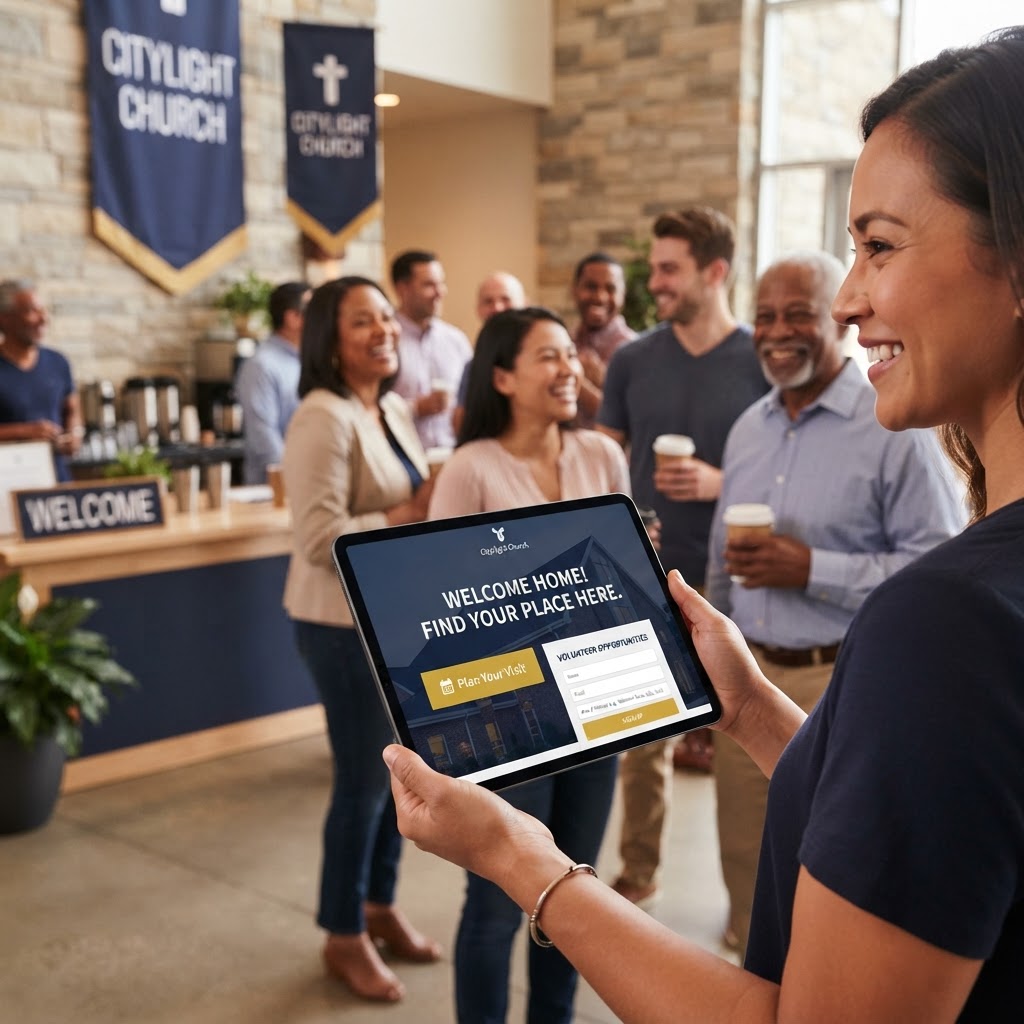
Your church website has two primary jobs: attract new visitors and recruit new volunteers. Everything else — sermons, events, giving — serves a congregation that only exists if the site first brings people in and then engages them in service. Yet most church websites are built for members, not for the people who haven't arrived yet. So how does a church website actually attract new visitors and new volunteers?
In this guide, we'll walk through the pages, features, and strategies that turn a church website from a digital brochure into a visitor- and volunteer-generating engine.
A church website that doesn't attract new visitors and recruit new volunteers is just an internal newsletter. The best sites are front doors — wide open, warmly lit, with a clear path inside.
How to Attract New Visitors Through Your Website
1. Be Found: Local SEO
Before a visitor can visit your site, they have to find it. When someone searches "churches near me" or "church in [city]," does your church appear? If not, you're invisible to seekers. Local SEO — optimizing your site for local search, claiming your Google Business Profile, and earning local backlinks — is the foundation of visitor attraction. See our local SEO for churches guide and general SEO guide.
2. A "Plan Your Visit" Page
This is the single most important page for new visitors. A "Plan Your Visit" page answers every question a first-time guest has:
- What time are the services?
- Where do I park? Is there a guest lot?
- What should I wear?
- What about my kids? Is there childcare?
- How long is the service?
- What happens when I walk in?
- Will I be called out or embarrassed?
A great "Plan Your Visit" page removes anxiety — and anxiety is the #1 reason seekers don't visit. Include photos of the building, the parking, the kids' area, and the sanctuary. Show them exactly what to expect.
3. A Homepage That Speaks to Seekers
Your homepage is your first impression. Within 5 seconds, a seeker should know:
- Where you are (city/neighborhood)
- When you meet (service times)
- What you're about (a warm, clear welcome)
- What to do next (a clear "Plan Your Visit" button)
Too many church homepages feature an insider photo, a tagline only members understand, and no obvious next step. Speak to the visitor, not the member. See our church website as digital front door guide.
4. "What to Expect" Content
Seekers are nervous. Content that demystifies your service — "Here's what a typical Sunday looks like" — lowers the barrier. Include:
- A brief description of the worship style
- What the teaching is like
- Whether there's communion and who can participate
- Whether there's an offering and whether visitors should give
- Whether kids stay in the service or go to kids' ministry
5. Sermon Samples
A seeker wants to know what the pastor sounds like. A page with 3-5 recent sermons — video or audio — lets them preview the teaching before they visit. This is one of the most-visited pages by seekers. See our sermon audio guide.
6. A Clear Beliefs Page
Seekers want to know what you believe — especially in an era of theological confusion. A simple, readable statement of faith helps them decide if your church is a fit. Don't hide it; don't bury it in jargon.
7. Authentic Photos
Stock photos of smiling models don't attract visitors — they signal a church that's hiding. Real photos of real people — your congregation, your building, your kids' ministry — build trust. Show the diversity, warmth, and authenticity of your church.
8. Stories and Testimonials
New visitor stories — "I was nervous my first Sunday, but..." — are powerful. So are member testimonials about how they found the church and grew there. Social proof lowers the anxiety of a first visit.
9. A Clear, Repeated Call to Action
Every page should have a next step — usually "Plan Your Visit" or "Contact Us." Don't make seekers hunt for what to do. Repeat the CTA throughout the site.
10. Mobile-Friendly and Fast
60% of seekers search for churches on their phone. If your site is slow or hard to use on mobile, they're gone. See our website speed guide.
How to Attract New Volunteers Through Your Website
1. A Dedicated "Serve" or "Volunteer" Page
Don't bury volunteer opportunities in a bulletin PDF. Create a dedicated page that lists every serving opportunity — greeter, kids' ministry, worship team, tech team, hospitality — with a brief description of what each role involves and the time commitment.
2. A Compelling "Why Serve?" Vision
People don't volunteer because they have free time — they volunteer because they're inspired. Cast a vision for serving: how it grows faith, builds community, advances the mission, and changes lives. Connect serving to the gospel, not to the church's need for warm bodies.
3. An Easy, Low-Pressure Sign-Up Form
The #1 reason people don't volunteer is that the process is unclear or intimidating. A simple form — "I'm interested in serving in: [dropdown]. Best time to reach me: [field]" — removes friction. Don't ask for a 5-year commitment upfront; invite them to "try it once."
4. Clear Role Descriptions
For each volunteer role, include:
- What the role involves
- Time commitment (weekly, monthly, seasonal)
- Whether training is provided
- Who to contact with questions
Ambiguity kills volunteerism. Clarity recruits it. See our church volunteer management guide.
5. Volunteer Testimonials
Stories from current volunteers — "I was nervous to join the kids' team, but it's been the best decision I've made at this church" — inspire others. Show the joy, growth, and community that serving brings.
6. "First Serve" Opportunities
Lower the barrier with "first serve" events — one-time, no-commitment serving opportunities (a community service day, a holiday outreach, a setup crew for an event). First serves let people try serving without a long-term commitment — and many convert to regular volunteers.
7. A Spiritual Gifts or Serving Assessment
A simple online assessment — "Discover how God has gifted you for serving" — helps members find their fit. Link the results to specific volunteer roles on the site.
8. Volunteer CTAs Throughout the Site
Don't limit serving to one page. Drop "Interested in serving?" CTAs on the homepage, on ministry pages, on sermon pages, and in the footer. Make it easy to say yes from anywhere.
Measuring Success: Are Visitors and Volunteers Coming?
How do you know if your site is attracting visitors and volunteers? Track these:
- Website traffic: Google Analytics — are visitors finding you?
- "Plan Your Visit" page views: Are seekers taking the next step?
- Plan Your Visit form submissions: How many are actually planning a visit?
- Volunteer page views and form submissions: Is interest translating to sign-ups?
- First-time visitor follow-up: How many website visitors actually show up on a Sunday?
- Search rankings: Are you appearing for "churches near me"?
Common Mistakes That Repel Visitors and Volunteers
- No "Plan Your Visit" page: Seekers have to guess what to expect
- Insider language: A homepage that only members understand
- Outdated content: A 2024 events page in 2026 signals a dead church
- No clear CTA: Visitors don't know what to do next
- Hidden volunteer info: Buried in a PDF or a members-only section
- Intimidating sign-up process: Long forms, background checks before first conversation
- Stock photos only: Feels inauthentic and cold
- No sermon samples: Seekers can't preview the teaching
- Slow or broken on mobile: 60% of seekers leave
How MyChurch Builds Visitor- and Volunteer-Attracting Sites
At MyChurch, we design church websites that don't just look good — they bring people in. Our Church Website Design service includes:
- A "Plan Your Visit" page built for seekers
- A homepage optimized for first impressions
- A dedicated, compelling "Serve" page with easy sign-up
- Local SEO built into the foundation
- Mobile-first, fast-loading design
- Authentic photography and testimonial frameworks
- Clear CTAs repeated throughout the site
- Analytics and conversion tracking
- Ongoing content and SEO management
Your church website should be your most effective tool for attracting new visitors and recruiting new volunteers. If it's not, schedule a consultation — and let us help you build a site that grows your church.
Ready to Transform Your Church's Digital Presence?
Schedule a free consultation with our ministry technology experts and discover how a custom church app or AI-powered tools can grow your congregation.
Book Consultation →