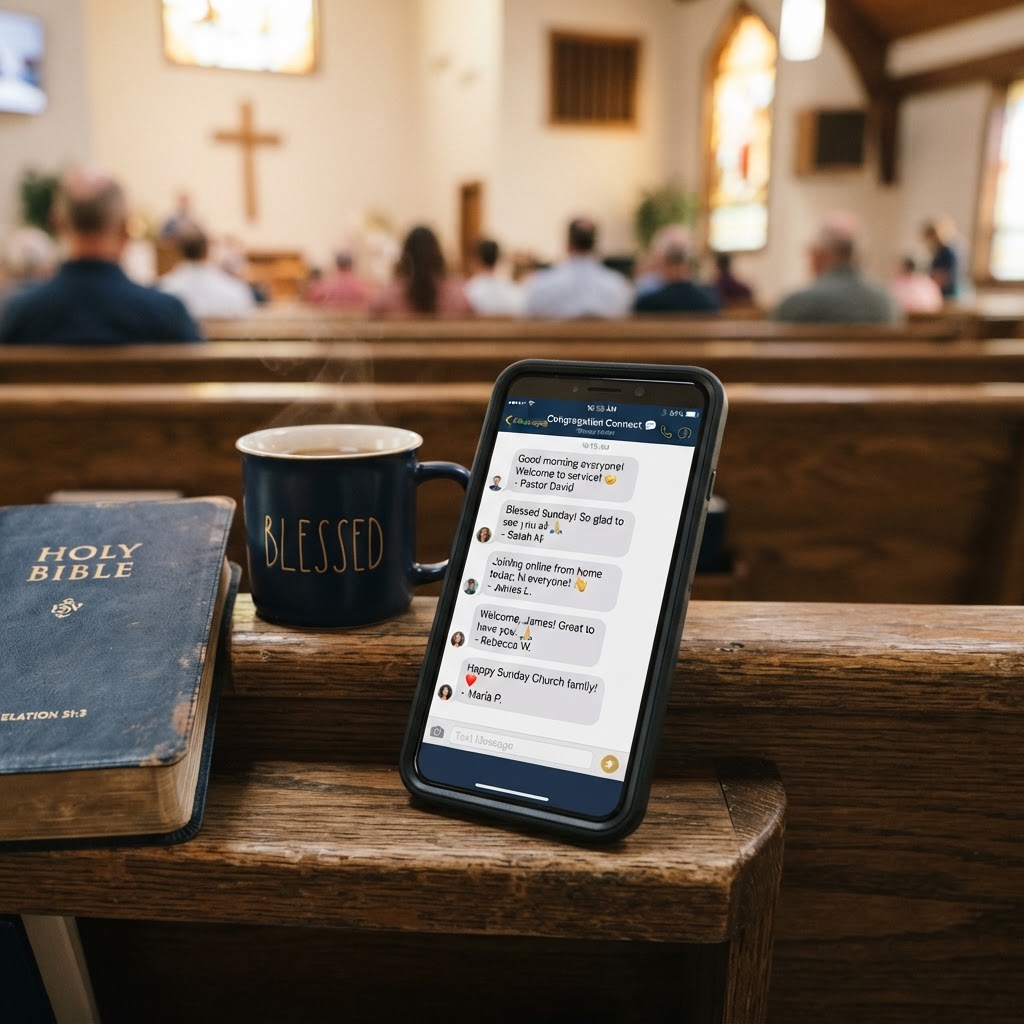
Email open rates hover around 20%. Social media posts reach 2-5% of your followers. But text messages? 98% open rate, most within 3 minutes. For a church trying to reach its congregation quickly and reliably, there's no more effective channel than a phone message. Whether it's a service time change, a prayer need, an event reminder, or a pastoral note, sending phone messages to your congregation is one of the highest-impact communication tools a church can adopt.
In this guide, we'll explore how sending phone messages to your congregation helps — and how to do it well. For a deeper dive, see our church text messaging guide.
You can't disciple people who don't hear from you. Text messaging ensures your congregation actually hears — every time, within minutes.
Why Text Messaging Works for Churches
- 98% open rate: Compared to 20% for email — your message is actually seen
- Speed: Messages are read within 3 minutes on average — perfect for urgent updates
- Everyone has a phone: No app to download, no account to create — every member can receive texts
- High response rate: People reply to texts — great for RSVPs and quick feedback
- Cuts through noise: Inboxes overflow, social feeds scroll past — texts get noticed
- Personal: A text feels personal — like a message from a friend, not a broadcast
How Sending Phone Messages Helps Your Church
1. Urgent Updates Reach Everyone Instantly
Service canceled due to weather? Building emergency? Pastor's sudden hospitalization? A text message reaches your entire congregation in seconds — no one shows up to a locked door.
2. Event Attendance Goes Up
A simple reminder text the day before an event — "Looking forward to seeing you at the marriage conference tomorrow at 7pm!" — significantly boosts attendance. Members forget; texts remind. See our church event promotion guide.
3. Giving Increases
A gentle text reminder — "It's the last day of the month — consider completing your giving goal here: [link]" — drives spontaneous gifts. Texts with giving links make generosity a one-tap action.
4. Pastoral Care Reaches More People
A pastor sending a quick text — "Praying for you today. How are you doing?" — reaches a member instantly and personally. For hospitalizations, grief, and crises, a text lets the pastor check in without interrupting. For broader care, a prayer need text mobilizes the congregation to pray.
5. Sermon and Content Engagement Rises
A text when a new sermon drops — "This week's message is live: [link]" — drives listening. Members engage with content during commutes, workouts, and quiet times.
6. Visitor Follow-Up Is Immediate
A first-time visitor who receives a text within 24 hours — "So glad you joined us! Here's a link to plan your next visit" — is far more likely to return. Speed matters in visitor follow-up. See our visitor follow-up guide.
7. Volunteer Coordination Improves
Coordinating volunteers via text — "We need 2 more greeters Sunday — anyone available?" — gets faster responses than email or phone trees. See our church volunteer management guide.
8. Member Retention Strengthens
Members who hear from their church during the week feel connected. Regular, thoughtful texts — devotionals, prayer prompts, encouragement — keep members engaged between Sundays. See our church member retention guide.
What to Send via Text Message
- Service time or location changes: Urgent, time-sensitive
- Event reminders: Day before and morning of
- Prayer needs: Mobilize the congregation to pray
- New sermon alerts: Link to listen or watch
- Give reminders: End of month, special campaigns
- Visitor follow-up: Within 24 hours of a first visit
- Volunteer requests: Quick recruitment and scheduling
- Pastoral check-ins: Personal, one-on-one care texts
- Devotionals: A daily or weekly scripture and thought
- Holiday and seasonal greetings: Christmas, Easter, Thanksgiving
Best Practices for Church Text Messaging
- Get consent: Never text someone who hasn't opted in — it's illegal (TCPA) and damages trust
- Use a dedicated church texting number: Don't text from a personal phone for mass messages
- Keep it short: Texts should be brief — a few sentences, not a paragraph
- Include a clear action: A link, a reply prompt, or a time — make the next step obvious
- Don't over-send: 2-4 messages per week is plenty — more feels like spam
- Segment your lists: Don't send youth events to seniors — target messages to the right groups
- Time it well: Avoid early morning and late night — mid-morning and early afternoon work best
- Make opting out easy: Always include "Reply STOP to unsubscribe" — it's the law
- Personalize when possible: Use the member's first name — it increases engagement
- Proofread: A typo in a mass text is embarrassing — read it twice before sending
- Pair with other channels: Texts are great for urgency, email for depth, social for outreach — use all three
Tools for Church Text Messaging
Several platforms are built for church text messaging — offering mass texts, group segmentation, scheduling, and two-way conversation:
- Church texting platforms: Tithe.ly, Pushpay, Gloo, Text-in-Church — purpose-built for churches
- ChMS with texting: Many church management systems include texting (Planning Center, Breeze, Realm)
- General SMS platforms: Twilio, SimpleTexting — more flexible but less church-specific
- Church app with push: A church app with push notifications offers similar immediacy with richer content — see our push messages guide
For most churches, a purpose-built church texting platform is the simplest, most compliant choice.
Text Messaging vs. Church App Push Notifications
Churches sometimes wonder whether they need text messaging if they have a church app with push notifications. They're complementary, not redundant:
- Text messaging: Reaches everyone — even members without the app. Higher open rate. Best for urgent, broad communication.
- App push notifications: Reach only app users, but allow richer content — links to sermons, giving, events inside the app. Best for engaged members.
- Use both: Texts for everyone and urgency, app pushes for engaged members and deeper engagement
See our church app guide for the full case for a church app.
Etiquette and Ethics
- Respect quiet hours: Don't text before 8am or after 8pm unless it's a true emergency
- Don't text sensitive info: Avoid personal pastoral details in mass texts — use individual messages for private care
- Honor STOP requests immediately: The law requires it, and respect demands it
- Don't guilt-trip: "You haven't given this month" is manipulative — frame giving invites positively
- Be authentic: Sign texts with a name — "Pastor John" — not just "First Church"
- Avoid over-automation: Automated texts are fine for reminders, but pastoral care should be personal
How MyChurch Helps Churches Communicate
At MyChurch, we help churches build communication strategies that reach their congregation effectively — from text messaging to church apps, email, and social media. Our Website Management service includes consulting on the full communication stack your church needs.
Sending phone messages to your congregation is one of the simplest, highest-impact communication tools a church can adopt. With 98% open rates and instant delivery, it ensures your people actually hear from you — whether it's an urgent update, a prayer need, or a simple reminder that they're loved and remembered. Schedule a consultation to build a church communication strategy that works.
Ready to Transform Your Church's Digital Presence?
Schedule a free consultation with our ministry technology experts and discover how a custom church app or AI-powered tools can grow your congregation.
Book Consultation →