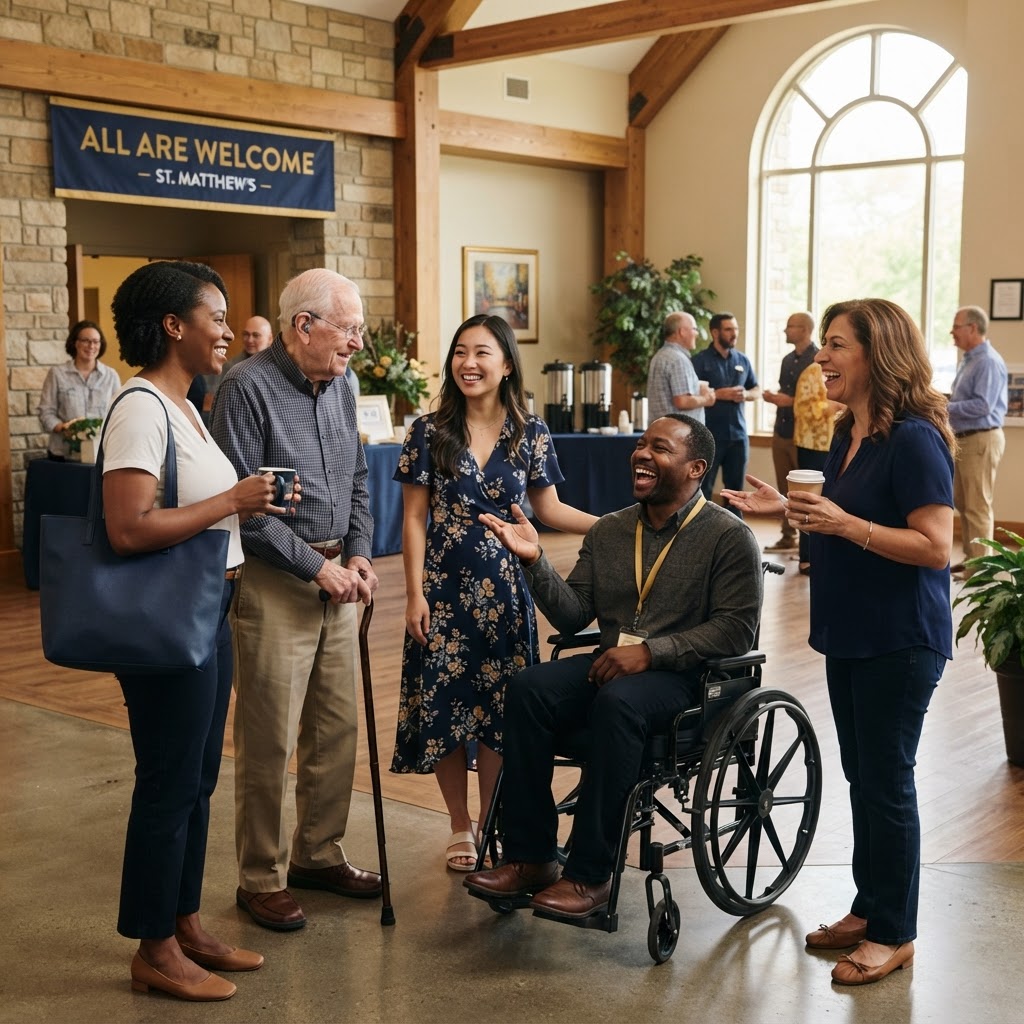
When we talk about ADA compliance, it's easy to get lost in technical standards, legal jargon, and WCAG checklists. But behind every accessibility barrier is a real person — a member of your congregation, a visitor looking for a church home, a neighbor seeking hope. Accessibility isn't about code. It's about people.
In this article, we want to put faces to the issue — to introduce you to the members and visitors your church website may be unintentionally excluding, and to show why thinking about them is one of the most important things your ministry can do.
"I went to five church websites looking for a place to belong. Only one had captions on their sermon videos. Only one made me feel like they'd thought about me." — A deaf seeker
Sarah: The Blind Member Who Uses a Screen Reader
Sarah has been blind since birth. She navigates the web using a screen reader — software that reads aloud the text on a webpage. She's a faithful member of her church, but when she tries to check the event calendar on her church's website, she hears "image, image, image" — because the calendar is a graphic with no alt text.
She can't find the service times. She can't read the pastor's blog. She can't submit a prayer request because the form fields have no labels. Her church loves her — but their website tells a different story.
- What she needs: Alt text on every image, proper heading structure, labeled forms, keyboard-navigable menus
- What she feels when excluded: Forgotten, invisible, like her church hasn't considered her existence
Michael: The Deaf Visitor Searching for a Church
Michael recently moved to a new city. He's deaf and looking for a church community. He visits church websites to watch sermon videos and get a sense of each congregation's message. On most sites, the videos have no captions. He watches the pastor's lips move, sees the congregation react — but he can't access a single word.
One church has captions on every sermon. Michael watches three sermons, feels welcomed, and visits the following Sunday. That church didn't just win a visitor — they lived out the gospel by thinking about him.
- What he needs: Captions on all video content, transcripts for audio sermons and podcasts
- What he feels when excluded: That the church's message isn't for him — that he's an afterthought
Robert and Eleanor: The Elderly Couple with Low Vision
Robert is 78. Eleanor is 81. They've been members of their church for 40 years. They use the church website to check the bulletin, read the prayer list, and find out about potluck dinners. But the website uses tiny gray text on a white background — stylish, perhaps, but unreadable to them.
Robert tried zooming in, but the text doesn't scale. He tried increasing contrast, but there's no option. Eventually, he calls the church office every week to ask what's in the bulletin — because the website is useless to him.
- What they need: Scalable text (at least 200%), strong color contrast (4.5:1 minimum), readable fonts, simple navigation
- What they feel when excluded: Left behind by their own church — as if their decades of faithfulness don't matter online
David: The Member with Motor Disabilities
David has cerebral palsy. He can't use a mouse — he navigates the web entirely with his keyboard, using the Tab key to move between links, buttons, and form fields. On most church websites, he gets stuck. The menu won't open with the keyboard. The form won't submit. The video player controls are unreachable.
David wants to give online. He wants to register for the men's retreat. He wants to sign up to volunteer. But the website won't let him do any of it — because no one thought about keyboard navigation.
- What he needs: Full keyboard operability, visible focus indicators, logical tab order, accessible form controls
- What he feels when excluded: That his desire to participate doesn't matter — that the church built its digital doors for everyone except him
Maria: The Visitor with a Cognitive Disability
Maria has a mild cognitive disability. She reads slowly and struggles with complex language and cluttered layouts. When she visits a church website packed with dense paragraphs, animated banners, and confusing navigation, she feels overwhelmed and leaves.
A simple, clearly organized website with plain language, consistent menus, and a clean layout would let Maria explore your church at her own pace. Instead, she's shut out by design choices that prioritize flash over clarity.
- What she needs: Clear, simple language, consistent navigation, readable fonts, minimal distraction, predictable layout
- What she feels when excluded: That church is too complicated for her — that she doesn't belong
James: The Parent Researching Churches for His Family
James and his wife have a son with autism. They recently moved and are looking for a church that will welcome their family. They research churches online — reading about programs, values, and accessibility. When a church website is itself inaccessible, they make a quick judgment: this church hasn't thought about families like ours.
An accessible website signals that a church is thoughtful, inclusive, and prepared to welcome people of all abilities. It's often the first — and sometimes only — impression a family like James's will have of your church.
Why Thinking About Them Is Ministry
Every person described above is real — not a hypothetical, but a representation of the 26% of American adults who live with a disability. They are your current members, your future visitors, and your community neighbors. When your church website is inaccessible, you're not just failing a technical standard — you're failing people.
Accessibility is one of the most practical, tangible ways your church can live out the gospel. The same Christ who touched the blind, spoke to the deaf, and healed the paralyzed calls his church to do the same — and in 2025, that includes the digital spaces where people first encounter your ministry.
Read our companion articles: Why a Church Needs to Be ADA Compliant and Website ADA Compliance and Why It Matters.
What Your Church Can Do Today
- Add alt text to every image on your website — describe what the image conveys
- Add captions to every sermon video and transcript to every audio sermon
- Increase text size and contrast — test your site on a small phone in bright sunlight
- Test keyboard navigation — unplug your mouse and try to use your site
- Simplify your language — write clearly, use headings, and break up long paragraphs
- Install an accessibility widget — give users control over text size, contrast, and more — see our widgets guide
- Get a professional audit — our ADA service includes a full audit and remediation
Thinking about these members and visitors isn't just the right thing to do — it's the gospel thing to do. When your church website welcomes everyone, your ministry grows, your reach expands, and your digital front door becomes the open door Christ intended it to be. Schedule a free accessibility audit today.
Ready to Transform Your Church's Digital Presence?
Schedule a free consultation with our ministry technology experts and discover how a custom church app or AI-powered tools can grow your congregation.
Book Consultation →