Website ADA compliance isn't a trend, a buzzword, or a nice-to-have. In 2025, it's a legal requirement, a moral obligation, and a strategic advantage — and yet the majority of church websites still fail basic accessibility tests. If you've ever wondered whether ADA compliance really matters, this article will give you the complete picture.
We'll cover why it matters legally, why it matters to your members, why it matters to your ministry's growth, and what you stand to lose by ignoring it.
An inaccessible website isn't just a technical failure — it's a closed door. And a closed door is the last thing a church should ever have.
What Is Website ADA Compliance?
Website ADA compliance means designing and maintaining your website so that people with disabilities can use it equally. The standard most commonly referenced is WCAG 2.1 Level AA — the Web Content Accessibility Guidelines developed by the W3C.
Compliance covers a wide range of disabilities and technical requirements:
- Blindness and low vision: Alt text, screen reader support, color contrast, text scaling
- Deafness and hearing loss: Captions, transcripts, visual alternatives to audio
- Motor disabilities: Keyboard navigation, accessible forms, sufficient click targets
- Cognitive disabilities: Clear language, consistent navigation, error prevention, readable fonts
- Seizure disorders: No content that flashes more than 3 times per second
Why It Matters Legally
The legal landscape has shifted decisively. Courts across the country have ruled that websites are "places of public accommodation" under the ADA — meaning inaccessible websites can be the basis of a federal lawsuit.
- 4,000+ ADA web lawsuits filed annually — and rising every year
- $25,000+ average settlement — not including legal fees
- Nonprofits and churches are not automatically exempt — many have been named in suits
- Plaintiff firms use automated scanners to find non-compliant sites and send demand letters by the thousands
A demand letter doesn't even need to become a lawsuit to cost you. Many churches settle quietly to avoid legal fees — paying thousands for a problem that could have been prevented for a fraction of the cost. Read our full legal breakdown in Why a Church Needs to Be ADA Compliant.
Why It Matters to Your Members
26% of American adults live with a disability. That means roughly one in four people in your congregation and community — members, visitors, givers, volunteers, and seekers — may face barriers on your website. When your site is inaccessible:
- A blind member can't read your prayer list
- A deaf visitor can't access your sermon videos
- An elderly member can't read your event calendar
- A member with motor disabilities can't fill out your giving form
- A parent of a child with disabilities chooses a more welcoming church
These aren't abstract scenarios — they're happening on church websites every day. Accessibility is how you tell these people: we see you, we value you, and you belong here. See ADA: Thinking About These Members and Visitors for the human stories.
Why It Matters to Your Ministry's Growth
1. Accessibility Improves SEO
Google's algorithm rewards accessible websites. Alt text, clear headings, descriptive links, fast load times, and mobile-friendly design are all accessibility practices that also boost search rankings. An ADA-compliant church website is more likely to appear when seekers search "churches near me." Learn more in our local SEO guide.
2. Accessibility Builds Trust
First impressions happen online. A polished, accessible website signals professionalism and care. Visitors judge your church by your website before they ever visit in person. Accessibility shows you've thought about everyone — and that builds trust instantly.
3. Accessibility Drives Engagement and Giving
If members can't navigate your site, they can't give, register, or connect. Removing barriers directly increases engagement — and giving. An accessible giving page means more members can contribute. See church donation software.
4. Accessibility Expands Your Reach
One in four adults has a disability. An accessible website opens your ministry to a quarter of your community that an inaccessible site shuts out. That's not just the right thing to do — it's a significant growth opportunity.
What Happens If You Ignore ADA Compliance
- Lawsuits and demand letters: Legal costs, settlements, and reputational damage
- Lost members: People with disabilities leave for churches that welcome them digitally
- Lost visitors: Seekers and families judge your church by your inaccessible site and never visit
- Lower SEO rankings: Google deprioritizes inaccessible sites — fewer seekers find you
- Reduced giving: Members who can't navigate can't give online
- Reputational harm: A lawsuit or complaint becomes public — trust is broken
The WCAG 2.1 AA Standard: What It Requires
WCAG 2.1 AA is organized around four principles — POUR:
- Perceivable: Users must be able to perceive content — alt text, captions, sufficient contrast
- Operable: Users must be able to operate the interface — keyboard access, no time limits, clear focus indicators
- Understandable: Content and operation must be understandable — plain language, consistent navigation, error prevention
- Robust: Content must work with assistive technologies — semantic HTML, valid code, ARIA labels
Meeting AA compliance involves dozens of specific requirements — from color contrast ratios (4.5:1 for normal text) to heading hierarchy to form labeling to video captions. It's a comprehensive standard, and it requires both proper design and ongoing maintenance.
Accessibility Widgets vs. True Compliance
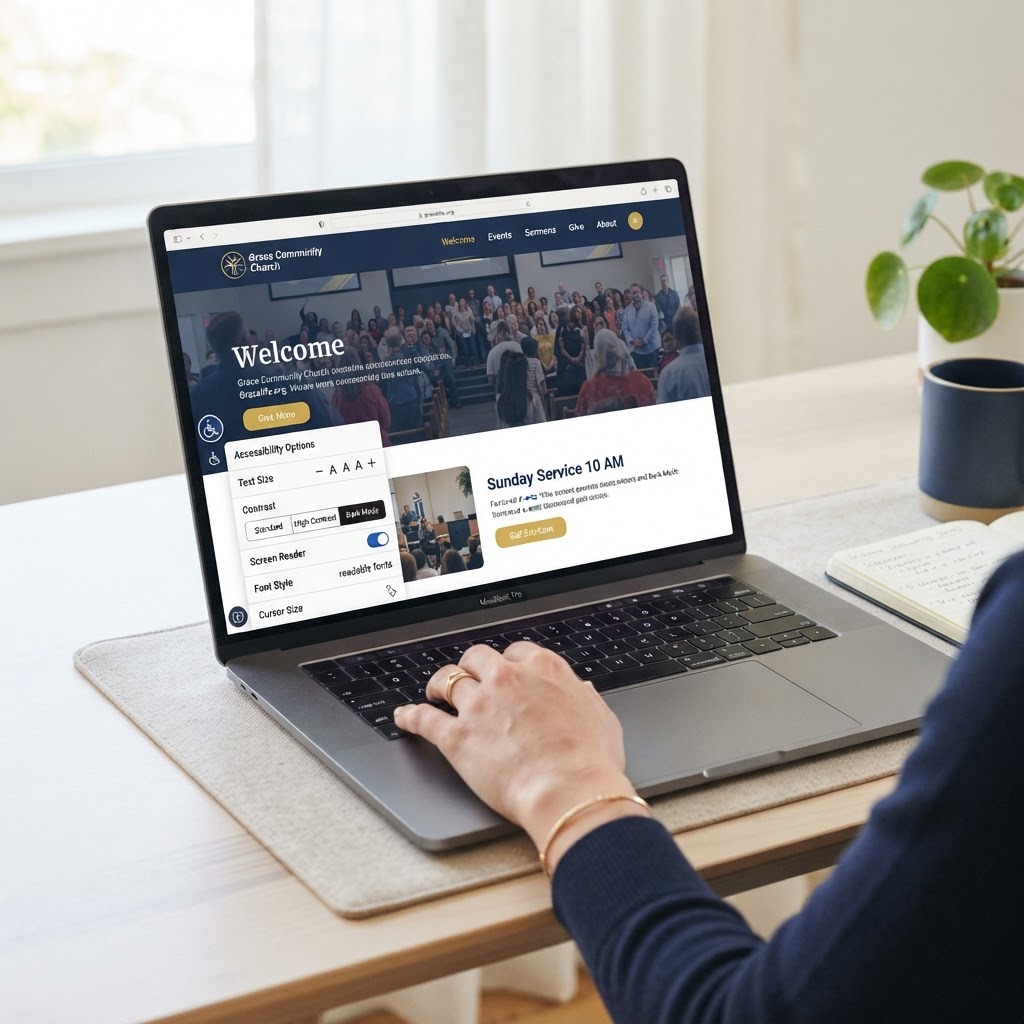
Many churches install an accessibility widget (an overlay menu with text size, contrast, and cursor options) and assume they're compliant. Widgets are helpful — they give users control and improve the experience — but they don't fix underlying code issues.
True compliance requires structural remediation: proper HTML, alt text, keyboard support, captions, and form labels — plus a widget for user empowerment. Both are needed. See our ADA compliance widgets guide for more.
How to Achieve and Maintain Compliance
- Audit: Get a full WCAG 2.1 AA audit of your current website
- Remediate: Fix every identified barrier — structural code fixes, not just a widget
- Add a widget: Install a customizable accessibility menu for user control
- Caption all media: Add captions to every sermon video and transcripts to audio
- Test: Test with screen readers, keyboard navigation, and contrast analyzers
- Maintain: Review every new page and content update for compliance before publishing
- Publish a statement: Add an accessibility statement page to your site
How MyChurch Makes Compliance Simple
At MyChurch, we handle ADA compliance end-to-end through our ADA Accessibility service:
- Full WCAG 2.1 AA audit of your current site
- Complete remediation of every accessibility barrier
- Customizable accessibility widget on every page
- Captions, alt text, keyboard navigation, and form labeling
- Ongoing compliance monitoring on every content update
- Quarterly full-site accessibility audits
- Accessibility statement page
Website ADA compliance matters — legally, morally, and strategically. It protects your church from lawsuits, welcomes every member and visitor, improves your search rankings, and grows your ministry's reach. Don't wait for a demand letter to take action. Schedule a free accessibility audit today and make your website a door that's open to everyone.
Ready to Transform Your Church's Digital Presence?
Schedule a free consultation with our ministry technology experts and discover how a custom church app or AI-powered tools can grow your congregation.
Book Consultation →